
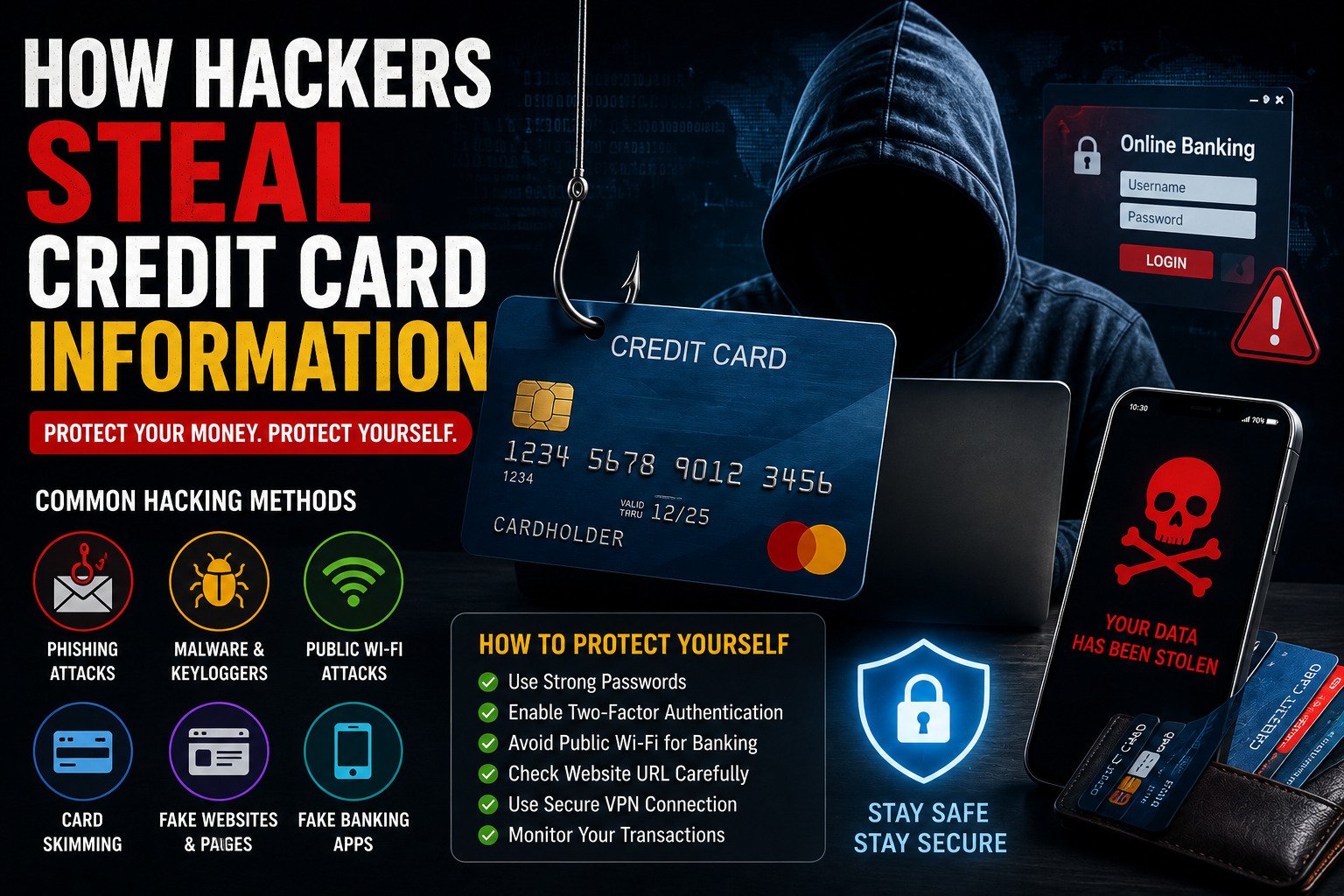
How Hackers Steal Credit Card Information
Learn how cybercriminals use phishing attacks, online banking fraud, and cyber scams to steal debit and credit card information. Discover secure online payment and fraud prevention strategies.
Credit card fraud and online banking scams are increasing rapidly worldwide. Hackers constantly target users through fake websites, malware, phishing emails, and unsecured internet connections to steal sensitive financial information.
Never share One-Time Passwords (OTPs), CVV validation numbers, or core banking passwords with anyone online, via unencrypted text strings, or over unverified telephone channels.
Common Ways Hackers Steal Credit Card Information
| Fraud Method | Description |
|---|---|
| Phishing Attacks | Fake emails, spoofed communication channels, or cloned landing pages designed to harvest system credentials and financial card data parameters. |
| Public WiFi Attacks | Intermediate threat actors utilize packet interceptors to monitor and capture unencrypted data streams over open unverified public hot-spots. |
| Malware | Malicious software applications, spyware payload scripts, or background keyloggers capture typed credential records secretly. |
| Card Skimming | Physical overlay units installed on point-of-sale terminals or automated teller machines read magnetic strips and record pin tracking data. |
| Fake Banking Apps | Malicious third-party applications wrap fraudulent front-end panels to skim account authorizations cleanly. |
What is Online Banking Fraud?
Online banking fraud happens when cybercriminals leverage unauthorized access points to control legitimate banking accounts, payment systems, or debit configurations to process fraudulent balance transfers or scrape consumer record data.
How Phishing Attacks Work
Phishing operates primarily on social engineering manipulations, tricking users into validating credentials on counterfeit platforms modeled closely to authentic gateways:
- 📧 Maliciously crafted fraudulent bank emails
- 📱 Spoofed emergency SMS warning links
- 💳 Fake overlay e-commerce checkout checkouts
- 👥 Coordinated social media impersonation threads
- 📞 Fraudulent incoming support technician calls
How to Protect Debit Card Online
- 🔐 Enforce mandatory secondary factor authentication.
- 🔑 Generate isolated high-entropy password strings.
- 📡 Avoid logging into primary financial vaults over public networks.
- 📊 Audit ledger transactions and account balances frequently.
- 🛡️ Route active traffic through audited cryptographic VPNs.
- 🛑 Maintain absolute dynamic secrecy of token strings and CVV blocks.
Secure Online Payment Tips
Always verify cryptographic handshakes by confirming HTTPS certificates before committing transactional tokens:
- 🛒 Restrict checkout operations only to highly trusted vendors.
- 💳 Deploy isolated single-use virtual debit cards.
- 🔔 Activate immediate SMS and mobile push alert tracking.
- 🔄 Keep official core banking platform code updated instantly.
- ❌ Deny incoming push-notification or dynamic payment claims.
Cyber Fraud Prevention Strategies
Developing resilient cyber fraud protection requires deep behavioral security awareness combined with clean technical isolation habits. Integrating client-side security software matrices alongside encrypted passkey managers drastically lowers entry opportunities for external hacking scripts.
Signs Your Card Information May Be Stolen
Monitor your profiles closely for these primary system anomalies:
Create Secure Passwords for Banking
Generate strong passwords instantly to protect your online banking and payment accounts from hackers.
Frequently Asked Questions
1. Can hackers steal credit card information through WiFi?
Yes. If an public network setup lacks end-to-end transport layer encryption layers, intermediate entities can track data packets passing over the open air interface seamlessly.
2. What should I do if my debit card is hacked?
Immediately coordinate a cold card freeze block through your official banking portal, file formal dispute notifications, update secondary security strings, and observe all related profiles for cascading logs.
3. Are online banking apps safe?
Official platform builds validated via authorized application stores leverage high standard application security architectures. However, side-loading configurations or untrusted root environments introduce vulnerabilities.
Related Articles
Warning Signs of Credit Card Fraud
- Unexpected transactions
- Unknown merchant charges
- Unauthorized online purchases
- Account alerts you did not initiate
- Changes to account information without permission
- Declined cards despite sufficient balance
If suspicious activity is detected, contact the card issuer immediately.
How to Protect Your Credit Card Information
- Use strong and unique passwords
- Enable multi-factor authentication
- Monitor account activity regularly
- Keep devices updated
- Avoid suspicious links and attachments
- Shop only on trusted websites
- Use secure payment methods
- Review credit card statements frequently