
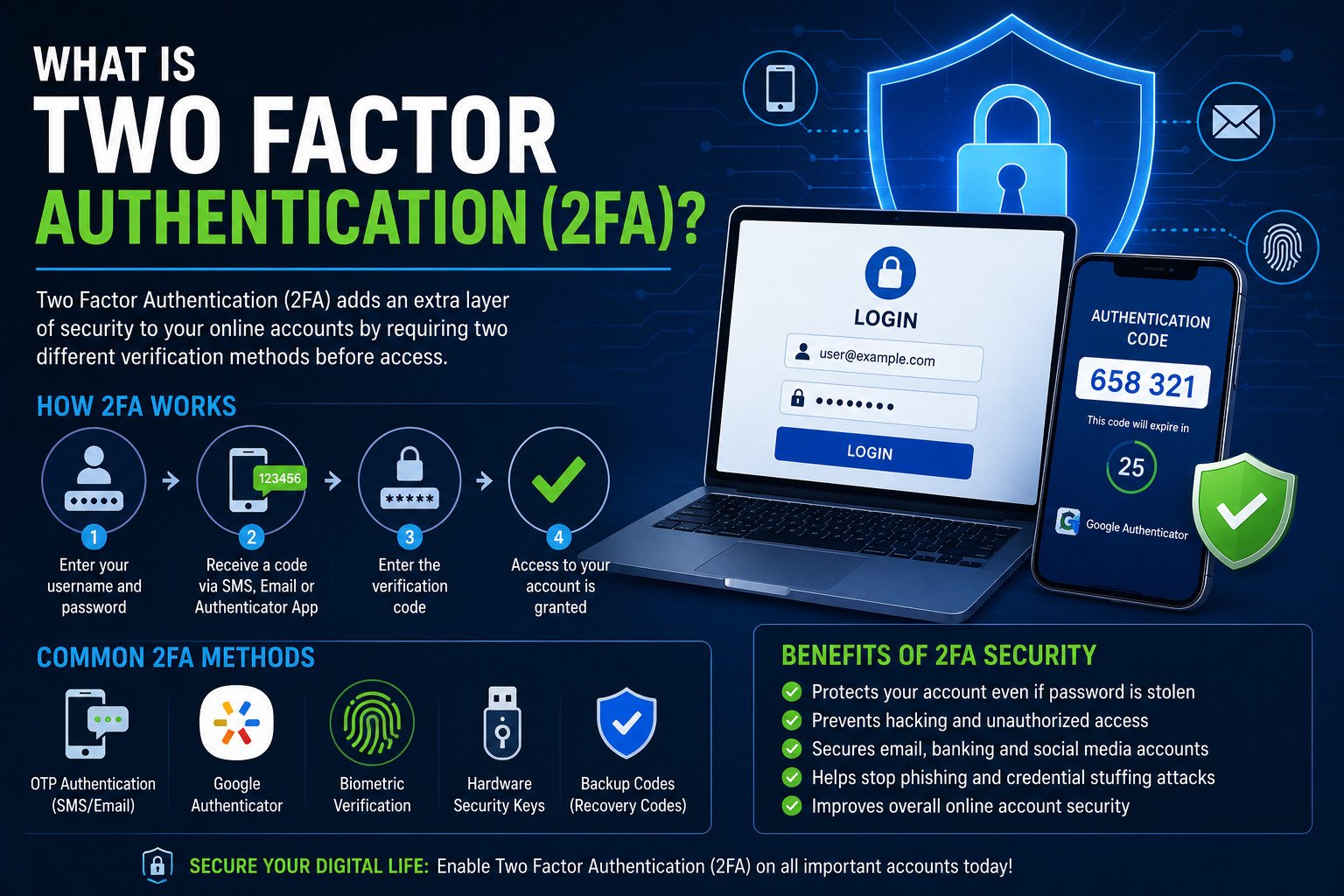
What is Two Factor Authentication (2FA)?
Learn how two-factor authentication, multi-factor authentication, OTP authentication, and secure login methods improve online account security and protect users from cyber attacks.
Cybersecurity threats and password leaks are increasing rapidly across the internet. Two-factor authentication, also known as 2FA security, adds an extra layer of protection to online accounts and secure login methods.
🛡️ 2FA Security Tip:
Even if hackers steal your password, they cannot access your account without the second verification phase token or authorization confirmation step.
What is Two Factor Authentication?
Two-factor authentication is a security system that requires users to verify their identity using two different authentication methods before accessing online accounts.
Traditional passwords alone are no longer enough for online account security. 2FA security improves protection by adding a second verification method such as OTP authentication, fingerprint scanning, or hardware identity tokens.
How 2FA Security Works
| Authentication Step | Description / Technology Layer |
|---|---|
| Password Verification | User enters username and primary cryptographic text string password. |
| OTP Authentication | One-time validation code transmitted through secure SMS or email channels. |
| Google Authenticator | Time-based one-time password (TOTP) generator application creating secure local codes. |
| Biometric Verification | Advanced physical endpoint security validation via fingerprint or face recognition systems. |
Why Multi Factor Authentication is Important
Multi-factor authentication reduces hacking risks and protects profiles from phishing attacks, automated credential leaks, and cyber fraud structures.
- ✓ Improves central profile database protection
- ✓ Protects direct financial and banking records
- ✓ Blocks automated dictionary attacks
- ✓ Secures primary communications channels
- ✓ Neutralizes credential phishing threats
Best Secure Login Methods
Deploying diverse defensive validation layers guarantees maximum barrier insulation against entry breaches:
- 🔑 Real-time Dynamic OTP Authentication
- 📱 Local Cryptographic Authenticator Software
- 🧬 Hardware Biometric Scanning Profiles
- 📟 Physical USB Hardware Security Keys
- ✉️ Out-of-band Email Verification Loops
What is Google Authenticator?
Google Authenticator is one of the most popular 2FA security apps. It generates local time-based secure login codes that users must enter along with their master authentication passwords before session approvals.
⚠️ Confidential Warning:
Never expose structural OTP codes or Google Authenticator backup seed keys to anyone across unverified digital chat interfaces or emails.
Benefits of Two Factor Authentication
Difference Between 2FA and MFA
Two-factor authentication explicitly restricts validation parameters to exactly two distinct credential types, while multi-factor authentication encompasses an extended architecture that may incorporate a series of independent verification checks such as passwords, behavioral identifiers, local tokens, and contextual geolocation profiles.
How to Enable 2FA Security
Create Strong Passwords for Better Security
Generate strong passwords instantly and improve your online account security with heavy cryptographic character combinations.
Online Account Security Best Practices
- 📅 Deploy exclusive unique credential keys for every standalone portal.
- 🔒 Enforce secondary validation routines wherever the feature is available.
- 🛑 Isolate and flag deceptive phishing attachments immediately.
- 🔄 Cycle central administrative passkeys after global breach notices.
- 📂 Coordinate system identities via modern encrypted credential managers.
Frequently Asked Questions
1. Is two factor authentication safe?
Yes, activating secondary authentication configurations significantly decreases structural entry vulnerabilities, blocking bulk scripted hacking efforts.
2. Can hackers bypass 2FA security?
No security solution is fully absolute against advanced targeted social engineering or session hijacking, but 2FA raises defensive barriers exponentially higher than plain passwords.
3. Which is better: OTP authentication or Google Authenticator?
Local application options like Google Authenticator are inherently superior because mobile network SMS OTP routing vectors can be intercepted via cellular SIM-swap exploits.
Related Articles
Trusted Resources to Check If Password Leaked Online
- Have I Been Pwned
- Cybersecurity and Infrastructure Security Agency (CISA)
- National Institute of Standards and Technology (NIST)